-
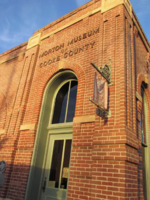 Morton Museum exterior
Photo of the building exterior of the Morton Museum of Cooke County in downtown Gainesville, Texas.
-
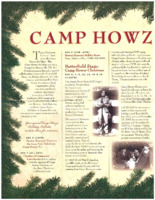 "Camp Howze Holidays" Brochure
This brochure was provided to the audience that attended the production of "Camp Howze Christmas." The brochure details the events that made up the commemorative celebration of "Camp Howze Holidays."
-
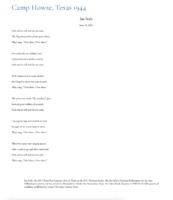 Camp Howze, Texas 1944
A poem by 2012 Texas Poet Laureate Jan Seale describes a memory of tagging along with her dad to Camp Howze. Her dad served as pastor of the First Baptist Church in Gainesville and would make trips to Camp Howze to hold religious services for soldiers at the camp.
-
 "Camp Howze Christmas" Program
This was the program that was provided to the audience that attended the production, "Camp Howze Christmas." The program lists the music included in Act one and Act two. It also features a lengthy description of Camp Howze and the effects the camp had on the Gainesville community.
-
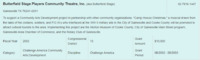 NEA Grant
The National Endowment for the Arts provided the Butterfield Stage Players Community Theatre with a $10,000 grant. The grant was awarded to various community organizations to support a neighborhood arts development project. This money was used to fund the production, "Camp Howze Christmas."
-
 "The Negro Soldier"
1944 Film produced by the U.S. War Department and directed by Col. Frank Capra to promote racial harmony and counter pervasive white supremacist views and subsequent mistreatment of Black American military members during WWII.
-
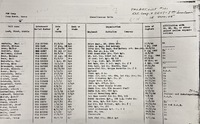 List of Prisoners of War
This is a list that includes several names of prisoners of war at Camp Howze. Additionally, the list includes the ranking of each POW within the German military.
-
 "The Negro Soldier"
Film Poster
Digital copy of cinematic poster promoting the WWII U.S. War Department's film titled "The Negro Soldier."
-
 "Army Makes Film on Negro Soldier"
Article in the Camp Howze Howitzer announcing a film commissioned by the U.S. War Department and directed by Col. Frank Capra in an effort to counter attitudes and acts of racism against black service members during WWII.
-
 "SSgt. Charlie David Mitchell, U.S. Army Veteran of WWII, Korean War, and Vietnam War"
This is a video interview conducted by researchers with the Library of Congress' Veterans History Project. The man interviewed was U.S. Army SSgt. Charlie David Mitchell, who, after 23 years of service, retired from the military. Though he he served in WWII, the Korean War, and the Vietnam War, the subject of his discussions in this interview is primarily related to his experiences in WWII.
-
 "The Organization and Role of the Army Service Forces"
The title page of John D. Millet's historical account of the creation, structure, and function of the United States Army Service Forces as they were determined and managed by its commander, Lieutenant General Brehon B. Somervell, during World War II.
-
 "The Employment of Negro Troops"
The title page for "The Employment of Negro Troops," a historical analysis of the government policies related to Black Americans' participation in the U.S. Army during World War II, written by Ulysses Lee as the U.S. Army's military history specialist and expert on this subject matter.
-
 "Gainesville Flocks to ASF Exhibit"
An article recalling the highlights of a show and tell event meant to educate the public about the Army Service Forces and all that they did at Camp Howze.
-
 "Indian Beats Record of Howze Hiker"
An article in the Camp Howze Howitzer mocking Native American soldier, Pfc. Clarence Blackcloud for setting a record during a 25 mile road march and outpacing a white soldier who was stationed at Camp Howze.
-
 "Colored Citizens Observe Holiday"
An article about black Gainesville residents coordinating with the local USO for black Camp Howze soldiers to celebrate the emancipation of people who had been enslaved in Texas.
-
 "Jewish High Holy Plans Made"
Article announcing plans for Gainesville's Jewish citizens to coordinate the High Holy Day services with Jewish soldiers stationed at Camp Howze.
-
 "Jewish Welfare Director of USO Arrives in City"
Announcement of the assignment of a Jewish associate director to one of the two service clubs available for white soldiers stationed at Camp Howze.
-
 "Rabbi Assigned to Camp Howze"
In this article the arrival of Chaplain Marvin J. Goldfine to Camp Howze is announced.
-
 Soldiers Before Americans
Recently naturalized American soldiers depicted in this photo are celebrated for their commitment to serving their adopted country.
-
 New American Citizens
Soldiers before citizens, these men were naturalized while stationed at Camp Howze.
-
 "GI Candlers"
A photograph of Japanese American soldier, Pfc. Matsuo Matsumoto, stationed at Camp Howze as a member of the Army Service Forces.
-
 Headquarters Detachment Softball Team
Photograph with a caption listing the member names of the Headquarters Detachment, which includes several Japanese American soldiers.
-
 "Latin Jive"
Feature article about Private Arcadio Ruiz and his musical talent published in the Camp Howze Howitzer.
-
 Camp Howze Howitzer Header
The USASF VIII Service Command Insignia can be found in the header of each Camp Howze Howitzer's front page marking their presence from the beginning until the end of Camp Howze.
-
 USASF VIII Service Command Patch
Service members assigned to the VIII Service Command of the United States Army Service Forces wore this eight-point star insignia as a left shoulder sleeve patch on their uniforms.
-
 Mess Hall Silverware
Mess hall silverware on display at the Morton Museum.
-
 Gainesville Army Air Field
Image of Gainesville Army Air Field.
-
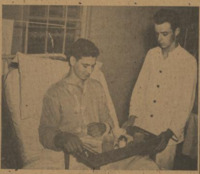 Meal Delivery
Mobile mess hall meal delivery to a recovering soldier at the Station Hospital.
-
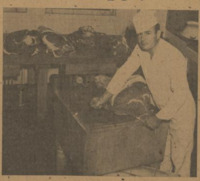 Butcher
Photograph of soldier slicing beef for Station Hospital patients.
-
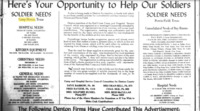 "Here's Your Opportunity to Help Our Soldiers"
Advertisement published in the Denton Record Chronicle asking for donations. Needs included hospital items, kitchen equipment, and recreational items.
-
 "GI Fun for This Week"
A schedule of USO activities was published in the Camp Howze Howitzer for each of the three service clubs.
-
 "Dear Mr. President" Recorded Interview of Private Smith, a Black WWII Soldier
In this 1942 recording, a black U.S. Army soldier, identified as Private Smith, stationed at Camp Polk, LA describes at great length, the widespread racism, discrimination, and degrading mistreatment that black service members endured each day from military members and civilians despite serving the country honorably with the hope of creating a better future for America.
Transcript:
00:14-07:34 “Mr. President, I am a Negro private in the United States Army. I’m a native of Austin, Texas. Thinking that you might be interested in the life of a Negro soldier and the treatment he gets in the United States Army. I was glad to have this opportunity to bring you some of the facts as I see them today. The negro soldier as a whole believes that he has something to fight for and believes in the outcome he will have more to fight for than he has now. But at the present time the Negro is treated with some discrimination in the army. It is probably because of the fact that the superior officers do not realize the sentiment that the Negro has. He feels that he has as much to fight for as any other man, but he do not like the treatment that the other people give him because at time they treat him with an inferior complex. The Negro realizes that in the past he has not got the promises that was made to him in the Declaration of Independence or in the Declaration of the Emancipation of slaves. Because at times the Negro is treated as he was before these things happened. Today the Negro fear that probably he has to fight for the promises that was made and it seem like sometime that these promises is all that he has to fight for because in the time that has passed they had not come into reality. But the Negro hopes that when these things are over, when the war is over, that these promises that had been made to him, the promises that he’s fighting for, the promises that he lives and hopes for, will all be a reality. We know, Mr. President, that you have not time to get out among these people and see the things that goes on and see the different actions and attitudes that people have towards the Negro soldier. In some states it is better than others. Especially in the southern states it is very bad. Of course, the southern state is Jim Crow but the Negro feel that when he is in the United States Army that he [sic] to be considered as never before or part of the United States and should not be treated as a dog or some other animal with such an inferiority complex because afterall the Negro, when he is in the army, is serving the same purpose that any other man is serving. He has the same duties to fear that any other man has to fear. And he feels that when he is in the service he should be given as much consideration as any other man. In the long run, the Negro feel that these things will come about because the Negro has faith in the President of the United States and the things that he stands for. And he believes deep down in his heart that the President of the United States do not believe in the way that the Negro is treated is right. And he hopes in the long run, the president will be able to do something about it. Of course, he know he’ll have to have cooperation of the Negro. The Negro is ready to give that. I’m stationed in Camp Polk, Louisiana. At the present time race discrimination is very bad. It’s not so bad in the army. Of course some things happen that shows that people still have that thing within ‘em that makes ‘em look upon the Negro as something that’s not human or something of that kind. But in the southern states the people, the civilian people, are very much so against the Negro and the Negro in uniform that at times it seems like they’d rather not have the Negro in the service. But the Negro feel and the Negro will, after all these treatments, do as much for this country as any other man, and that is give up his life because he feel like there’s tomorrow and tomorrow will bring the things that he has hoped and prayed for. I feel that I voiced the sentiment of every colored man and I’m really speaking from the depths of my heart that no man can do any more for the United States than I can. No man can fight harder for victory than I can. No man can do more to bring about the safeness of this country and the loved ones and the friends we have here than I can. And I feel like every soldier, every colored soldier, in the United States Army, feel within himself exactly as I do because after all, of whatever any man do, he can’t do anymore than give up his life. And that’s what every colored soldier in the United States Army that the flag waves over, that wears the United States colors, he feel like he has only one life to live and if it takes that life to make this country safe for democracy and the things that he hoped for and the things that has been promised to him, he’s ready to give up his life. He knows that he may not enjoy these things. He may not be able to see these things happen, may not see these things come about, but he realize in the future he have loved ones that he left behind at home and he has friends that he would like to see enjoy these blessings and he is ready to give up his life to make these things possible.”
-
"Dear Mr. President" 1942 Recording of David Helfeld, New York city college student
David Helfeld, a 19-year-old college student and the President of the Student Council at the College of the City of New York, speaks on behalf of himself and his fellow students regarding their mutual horror over the discrimination against Black Americans in the United States Armed Forces. He equates the mistreatment of Black Americans with the same fascism being fought by Americans overseas and insists it must be fought at home as well.
Transcript:
01:04-02:59 “...Dear Mr. President, My name is David Helfeld…I happen to have the honor to be the President of the Student Council of College of the City of New York. I’m only 19 now and I have a year before I graduate. Before I become 20 I intend to join the army. There’s just one thought I’d like to get across to you. It’s a feeling which horrifies all the boys at our college and that is negro discrimination in the army and in the navy. It seems to me to be an example, a very horrible example of fascism within democracy. When we here at the college hear that there are … purely Negro regiments and that Negroes are only allowed to do slop duty aboard the ships of our navy, it makes us feel very bad. We here realize that there are three wars to be fought; the physical war against the fascist nations - Germany, Italy, and Japan, and the war from within against anti-semitism, Jim Crow, and factors of that nature. We feel that as long as we have fascism at home it is rather futile to fight from the outside if we are not at the same time fighting it from within. I thank you for listening. Besides the two wars I’ve just mentioned I feel there is a third war, a very important one, namely the war to make a proper peace, peace which will do away with all wars in the future.”
-
 "Dear Mr. President" Audio Recording Jacket
Audio recording jacket for 1942 interview of Black Americans in Nashville, TN with handwritten descriptions of persons interviewed.
-
"Dear Mr. President" 1942 Recorded Interviews of Black Americans in Nashville, TN
00:10-01:20 Black American lawyer, Alexander Luvey, argued against the federal government entrusting racist local governments with the authority to oversee the administration of federal benefits for Black Americans.
Transcript:
“Mr. President, this is Alexander Luvey, a lawyer from Nashville, Tennessee. It is generally recognized that the Negroes of the South are not contributing as much as they can contribute to his national defense. Nor are they receiving the benefits which the federal government desires them to receive. This is due to the fact that the federal government is working through constituted local authorities. It is true that local served government is a theory of democratic government, but Mr. President, this is a condition and not a theory which confronts us Negroes in the South. When the head of our government publically announces that this is a white man's country, when the head of our local Department of Education fights vigorously to maintain a dual educational system paying different salary schedules, how can we expect that the local authorities will function fairly and efficiently for the Negro?...”
-
"Dear Mr. President" Recorded Interview of Black Americans in Nashville, TN, 1942
00:08-01:31, 01:36-02:42 Recorded interviews with several Black Americans from Nashville, TN addressing President Roosevelt with their concerns regarding discrimination against black citizens and abuse of black servicemen. The Nashville residents interviewed asked President Roosevelt for his understanding and assistance in protecting the rights of black citizens to serve their country.
Transcript:
“...I am thinking of 15 million Negroes who are among the most loyal citizens in the United States. In the face of discrimination and segregation the Negro has remained loyal. What greater proof than a Joe Louis benefit for the navy, a branch of our armed services which has never permitted his race to rise above the ships galley. These millions of negroes are doing all in their power to serve in the presence crisis. Most defense industries are closed to him. The possibility of advancement in the army is definitely limited. If Democracy is to survive. If Democracy is ever to be made to work, our generation must make it work. We want as you do, to perpetuate the democratic way of life. Do all in your power as we are doing to remove the barriers, raise the ceilings, unshackle the loyalties, release the energies and the initiative of this loyal race that together, all Americans, all liberty loving peoples may give their all that our way of life may survive.”
01:36-2:42 Mrs. Julia T. Glavin of Nashville, TN. “Mr. President, in this section of the United States it seems to me that there are two outstanding problems confronting us now. They have to do with our negro soldiers and taxation. In certain parts of our country the uniform of our army is not properly respected. Our loyal black boys in uniform should be protected while they’re in camp. The ruthless beating up and murdering of them should be stopped. This sort of thing breaks down the morale of any army. Every loyal soldier is an important factor in our defense program. It’ll take a lot of money to win this war. We’re going to win and we’re going to sacrifice all we have for our country, but it has become a problem to know how to meet these new taxes and keep up the old ones with our limited incomes which have not increased with the increased demand of heavy taxation. If we borrow we are plunged into debt, and citizens in debt cannot present as strong a defense as we desire, but we have pledged ourselves to do our best.”
-
 "Dear Mr. President" Audio Recording Jacket
Audio Jacket for "Dear Mr. President" interview of black residents in Nashville, TN during the winter of 1942.
-
 "Army Nurse Corps"
Full page photo and article in the black newspaper, The Oklahoma Eagle, highlighting the commitment of black nurses as commissioned officers of the United States Army Nurse Corps. Locations of duty mentioned in the article include the two hospitals serving black military service members in Texas, one of which was at Camp Howze.
-
 Sergeant Joseph H. Ward
An announcement in The Oklahoma Eagle, a black newspaper, honoring the military service of Sgt. James H. Ward, recently transferred from Camp Howze, TX to Camp Claiborne, LA as a member of the U.S. Army Service Force.
-
 Congressman, Ed Gossett
Headshot of Congressman, Ed Gossett.
-
"Dear Mr. President" by Miss Maude Gray
In this recording, Miss Maude Gray of Austin, TX relays her concerns regarding the mistreatment and discrimination black soldiers, like her brother, were forced to endure as service members in the U.S. military. She asks President Roosevelt to understand that black Americans want to serve in the military honorably. She explains why black Americans need the president's help to ensure they are treated with dignity and offered the same opportunities to serve their country as all willing, able-bodied Americans.
Transcript:
Miss Maude Gray speaks about her brother and other black soldiers’ experience with racist treatment in the military and by authorities unwilling to hire them. “…I got a brother who’s in the army….when he left here he was mighty glad to get in the army. I don’t know whether he’s so glad to be there now from all the letters I’ve been gettin from him. Mind you, I don’t mean that he’s against our country or anything like that, but he’s not so satisfied with the treatment that he’s gettin up there, he thinks that it could be a little better….” The young woman goes on to describe degrading mistreatment of her brother and his fellow black soldiers. She mentions public fears of race riots as the justification for keeping black soldiers from accessing and training with weapons. “They don’t have any entertainment for them, whereas the white soldiers have lounges, and guest houses, and everything that they could wish for as far as facilities will permit while our boys don’t have anything but a post exchange. And that’s not very good for entertainment and when that’s all he has to do. I think they could stand that if they were just treated a little better when it comes to other things that are most important duties, promotions. The navy won’t let you in. The army, when they get you, it put you off somewhere off by yourself…”
-
 Miss Maude Gray, "Negro Girl from Austin, Texas"
Jacket for the recording of Miss Gray in which she relays her concerns regarding the mistreatment and discrimination black soldiers, like her brother, were forced to endure as service members in the U.S. military. She asks President Roosevelt to understand that black Americans want to serve in the military honorably. She explains why black Americans need his help to ensure they are treated with dignity and offered the same opportunities as everyone else.
-
 "Chinese Soldiers in 86th at Howze Want to Fight Japs"
In this photograph and caption published in the Gainesville Daily Register, Chinese-American soldiers are admired for their service and determination to defeat the enemy in battle.
-
 Gainesville Negro Girl Lieutenant
This brief mention of a young black woman's commission as a Second Lieutenant in the U.S. Army Nurse Corps was a rare moment of acknowledgment for black service members in news publications covering the local region surrounding Camp Howze
-
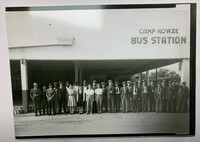 Camp Howze Bus Station
Picture of bus station employees outside of the Camp Howze bus station
-
 Gainesville Business Numbers
Not only did Camp Howze cause significant impacts on Gainesville's economy, but it allowed citizens to build more homes and businesses. Building permits increased from $127,853 in 1942, to &570,000 in 1946. The post office in Gainesville also hit higher numbers due to the soldiers from Camp Howze, as postal receipts went from $66,612 in 1942 to an all-time high of $193,000 in 1944.
-
 Gainesville Business numbers chart
This Chart helps us visualize the dramatic economic changes Camp Howze brought to Gainesville. Retail sales alone rose from $4,100,000 in 1939 to 7,677,000 just three years later. Overall deposits in Gainesville jumped from $3,761,780 in 1942 to $11,425,645 in 1944.
-
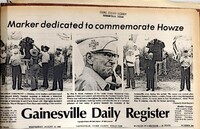 Marker dedicated to commemorate Howze
Gainesville Daily Register. August 18th, 1982 issue with a story printed regarding the dedication ceremony of the historic marker placed at the site of Camp Howze. The event took place on August 17th, 1982 but the story was printed the following day.
-
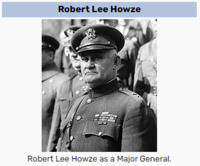 Robert Lee Howze Picture
A picture of the man who the camp is named after.
-
 Response from Mr. Gibson,
Civilian Aide to the Secretary of War
In this response letter to Private E.L. Reynolds, Mr. Gibson, implies that banning the Pittsburgh Courier, or any other "Negro publication" at Camp Howze would violate official War Department policy AG 461 Subject: Restriction of Commercial Publications. Mr. Gibson advises Pvt. Reynolds to write back with further details regarding this issue.