Archie Grant Oral History Transcript
Item
- Title
- Archie Grant Oral History Transcript
- Description
- Transcript of an oral history interview with Archie Grant, a WWII Army veteran who did basic training at Camp Howze.
- Date
- 1999, August 31
- Source
- UNT Oral History Collection
- Subject
- Archie Grant
- oral history
- historical memory
- Camp Howze
- UNT Oral History
- extracted text
-
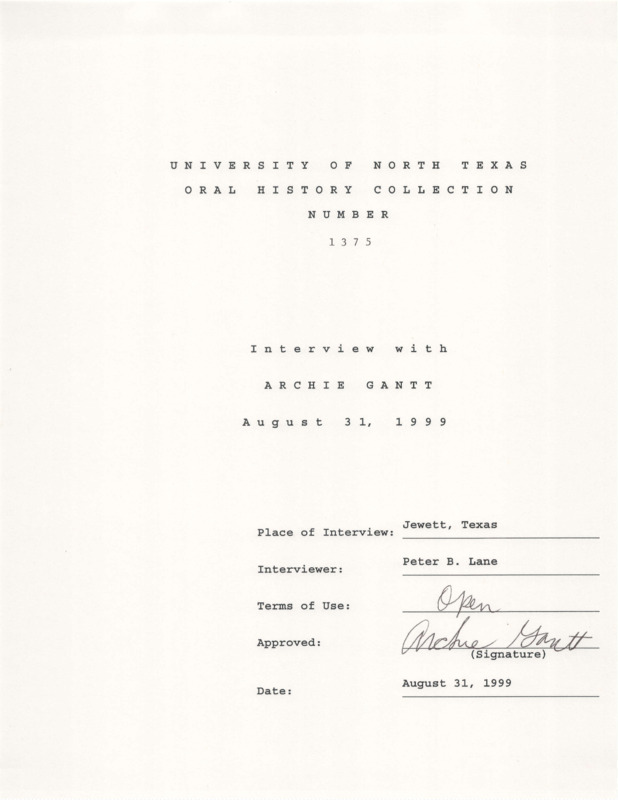
U N T V E R S I T Y
N O R T H
O F
O R A f J H I S T O R Y
T E X A S
C O L L E C T I O N
N U M B E R
L 3 7 5
w i t h
I n t e r v i e w
A R C H I E
3 L ,
A u g u s t
Prase of
G A N T T
rnterview.
Interviewer:
1 9 9 9
ilewett'
Peter
Texag
B. Lane
Terns of Uee:
Approved:
Date:
Auguet
3L,
1999
Copyright ©1999
THE BOARD OF REGENTS OF
THE UNIVERSITY OF NORTH TEXAS
IN THE CITY OF DENTON, TEXAS
All rights reserved. No part of this work may be reproduced or transmitted in any form by any
means, electronic or mechanical, including photocopying and recording, or by any information
storage or retrieval system without permission in writing from the Director of the Oral History
Program or the University Archivist, University of North Texas, Denton, Texas 76203
Oral History Collection
Archie Gantt
Interviewer:
Peter B. Lane
Place of Interview:
Dr. Lane:
My
August 31, 1999
Jewett, Texas
name
is
interviewer
interview
Peter
of
is
Lane,
Mr.
being
and
Archie
conducted
I
am
the
Gantt.
The
in
Jewett,
Texas, which is in central Texas. Present
during this interview is Mr. Gantt, who is
a World War II veteran of F Company, 335th
Infantry,
84th
Division,
myself,
and
Mr.
Troy Thomason is also in the room. He is a
friend of Mr. Gantt’s and a fellow veteran,
as
well
as
an
interviewee
in
the
Oral
History Program of the University of North
Texas.
Good
morning,
Mr.
Gantt.
It
is
my
honor to be with you here and spend some
time reflecting on your experiences in the
war itself.
Gantt:
Good morning.
Lane:
I would like to ask you to perhaps take us
through your early life, discussing your family
and
your
life
on
into
high
school,
if
you
would.
Gantt:
I was raised in this community. I was born here
on July 4, 1922. I went to grammar school at a
little place called Farrar, where I was born.
When I finished grammar school at Farrar, a new
high school had been completed in this part of
the country. It was called Fair Oaks. I went
there
for
four
years
and
finished
there
in
1940.
Lane:
Archie--if I may call you “Archie”--could you
say a little bit about your father and mother
and your siblings in your early life?
Gantt:
My father was a good business manager, even
during
the
Depression,
and
my
mother
was
a
hard-working lady. I had a brother who was two
years older than me and was drafted somewhat
earlier, in 1942. I had a sister who was two
years younger than me and one ten years younger
than me. They lived on the farm and worked
hard. My brother, sisters, and myself all went
2
to school at Fair Oaks.
We worked hard. My brother left pretty soon
after he got out of high school. He went to
Westminster College [in Westminster, Texas] for
one year.
Lane:
How
did
the
Great
Depression
affect
your
anything
any
family?
Gantt:
Well,
since
I
didn’t
know
different, I thought it was a matter of life.
Times were hard, but we had
plenty to eat.
There were plenty of people in that part of the
country who were hungry and who were very much
in need. I saw lots of needy people. We thought
that we were pretty fortunate.
Lane:
You always had food on the table?
Gantt:
Yes.
Lane:
Do you remember in the 1930s how you, as a
young man, became familiar with events going on
in Japan and Germany and Italy? Do you remember
how you came to know about [German Chancellor]
Adolf Hitler?
Gantt:
Most of the information that we got back in
those
days
was
by
a
battery-powered
radio.
Newspapers weren’t very prevalent back then,
3
and neither were magazines. So, a lot of it was
just word-of-mouth. We pretty well took what we
heard on the radio as being solid facts.
Lane:
Was Hitler portrayed as leader in Germany, or
was he somebody that the United States opposed
even in the 1930s?
Gantt:
He was presented as an evil influence because
of his repression of the masses.
Lane:
Did your father and yourself support Franklin
Roosevelt as president?
Gantt:
Oh, I was not of voting age at that time. My
daddy was a “Yellow Dog” Democrat.
Lane:
Would you define what a “Yellow Dog” Democrat
is?
Gantt:
A “Yellow Dog” Democrat is a fellow who would
vote
for
a
Democratic
yellow
ticket,
dog
if
rather
it
than
was
vote
on
for
the
a
Republican.
Lane:
So, your father was a supporter of the New Deal
and the efforts of President Roosevelt to take
the country out the Depression.
Gantt:
There
is
no
doubt
that
he
was
one
of
the
greatest men of our time. Franklin Roosevelt
was one of the greatest men of our time.
4
Lane:
Do you remember the conflict in America between
those who wanted to take a stronger role in
opposing Hitler and others, such as [Charles]
Lindbergh,
who
were
opposed
to
American
involvement in the European conflict?
Gantt:
I know that there were a lot of people who were
pacifists.
They
didn’t
want
to
get
involved
anywhere. I didn’t really know anything about
what was right or what was wrong along that
line. I had some moral values I cherished, but
I didn’t know how to cope with political ideas.
Lane:
Did you follow the religious beliefs of your
parents and attend their church?
Gantt:
Yes.
Lane:
What denomination were you a member of?
Gantt:
I was a member of the New Salem Baptist Church
in this community, and other Baptist churches
since
then.
I
used
to
aspire
to
be
a
song
leader, and I got to be one after a fashion. I
used to be a music director for churches for a
good long while.
When I had a stroke, I lost
my voice, and I lost my singing ability.
Lane:
You finished high school in 1940?
Gantt:
Yes.
5
Lane:
What were your plans for your life after high
school? This was before the Japanese attacked
Pearl Harbor, Hawaii, on December 7, 1941. What
were you going to do with you life after coming
out of high school?
Gantt:
I didn’t really know. I didn’t want to be a
farmer. I went to Fort Worth, Texas, and went
to work for a fellow at a service station for a
little while; and I went to West Texas for a
little while, but I got homesick and came home.
I stayed on the farm until I was drafted.
Lane:
Tell me how they picked you, of all people, to
join the U.S. Army.
Gantt:
I’m not sure exactly how that draft worked, but
there were a lot of men who were drafted in
1942. Nearly all of the men who were twenty
years old or older went.
Lane:
Why didn’t you enlist in the Army Air Corps, or
in the Navy, or in the Marine Corps? Why did
you wait to be drafted?
Gantt:
I don’t know that. I just put it off as long as
I could, I guess.
Lane:
So, unlike many young men after Pearl Harbor,
you didn’t rush to enlist in the service.
6
Gantt:
No. I was never a superpatriot.
Lane:
You decided early on to wait until you were
drafted?
Gantt:
That’s right.
Lane:
Did you ever oppose service in any way?
Gantt:
No.
Lane:
So, like many people, you were willing to go
when you were called.
Gantt:
Sure. That was my duty.
Lane:
Tell us about your official notice to report
and your first few days in the military. What
did “Uncle Sam” do with you?
Gantt:
We went to Camp Wolters [Mineral Wells, Texas]
for
induction,
examination,
inoculation,
and
for our clothes.
Lane:
Were all the people sent from Camp Wolters to
one place, or did they get assignments all over
the country?
Gantt:
They were sent all over the country.
Lane:
Tell us about your assignment and your reaction
when you received it.
Gantt:
We were sent to Gainesville, Texas, to Camp
Howze. It was a new camp.
Lane:
What do you mean by “we?”
7
Gantt:
There were several men from Limestone County.
There were six of us who went there. Some of
them went to the 45th Division, some went to
the 104th Division, and some went [here] and
some went [there]. Six of us from Limestone
County went to the 84th Division.
of
them
left,
but
the
other
Later, some
three
served
through the war.
Lane:
Did they ask you if you wanted to be a mechanic
or a supplyman or anything?
Gantt:
Yes. They asked you what branch you wanted to
be assigned to, but they put you where they
wanted you.
Lane:
What specialty did they give to you?
Gantt:
I don’t remember what my specialty was, but I
was put in a rifle company and in a weapons
platoon.
As time went along, I got to be a
section leader. It’s got an MOS number, but I
can’t recall what it was.
Lane:
So,
you
moved
Gainesville,
from
Mineral
Texas--which
is
Wells
just
up
to
north
of
Denton, Texas--part of the early cadre of the
84th
Division.
They
“Railsplitters.”
8
were
named
the
Gantt:
That’s right.
Lane:
Where did that name come from?
Gantt:
It was called the “Lincoln Division” in World
War I.
It has to do with Abraham Lincoln’s
ability to split the rails.
was
known
youth.
for
being
a
President Lincoln
rail-splitter
[Editor’s note:
in
his
Abraham Lincoln was
born in Kentucky but made his political career
in
Illinois,
and
he
served
in
the
Illinois
militia during the Black Hawk War of 1832.
84th
Division
was
formed
in
1917
The
from
federalized National Guard units from Illinois,
Kentucky,
and
Wisconsin.
The
division
was
dissolved after World War I ended in 1918, but
was reformed in 1943.]
Lane:
Describe what Camp Howze looked like. Was it a
sophisticated
base,
or
was
it
just
getting
built at the same time the unit was?
Gantt:
It was just getting built. All of the buildings
were tarpaper barracks. There was a heater at
each end of the barracks. Gainesville, Texas,
is a cold place.
I got pneumonia. I went on
sick call, and they didn’t examine me.
So, I
went back out to the drill field, and I had a
9
good-hearted
sick.”
lieutenant.
I
said,
“Sir,
He said, “Are you really sick?”
said, “Yes, sir.”
I’m
I
He said, “Come with me.”
So, we went to the aid station, and he said,
“Examine this man.”
They did, and they said,
“Go back to your quarters and get your toilet
articles. You’ve got to go to the hospital.”
It turned out that I had bronchial pneumonia,
and I stayed in the hospital for a few days
before I came back to my old company.
had a lot of
I always
respect for my lieutenant. He
always treated me fairly.
Lane:
Tell
us
about
the
relationship
between
the
enlisted men--most of whom were draftees--and
your NCOs [non-commissioned officers] and your
officers during this period at Camp Howze.
Gantt:
I always thought that I was treated fairly. We
had officers and sergeants who were “men of
heart.”
They wanted you to get the job done,
but they wanted to treat you fairly.
I saw
very few inequities in the service during all
the years that I served.
Lane:
Did you see any physical abuse by the officers?
Gantt:
Never.
10
Lane:
Tell us about your food. Were you satisfied
with it?
Gantt:
It was pretty good food, and there was plenty
of
it,
and
it
came
regularly.
I
have
no
complaints about it.
Lane:
Were the men of your unit all Texans, or did
they come from all areas of the United States?
Gantt:
They came from everywhere. A lot of them came
from California, and a lot of them came from
the Carolinas and Pennsylvania and New York.
Lane:
What did you learn from all of these different
people?
Gantt:
I learned that everybody has got a different
song to sing.
Lane:
Did you find them very different from yourself,
coming
from
this
rural
Baptist
community
in
Texas?
Gantt:
Yes, there were a lot of differences between
the different states. I developed friendships
with
people
states.
I
from
found
all
over,
all
different
that
there
are
good
men
everywhere you go.
Lane:
I guess that when you go through adversity, you
can
unify
with
people
11
of
very
different
backgrounds. I don’t know if you would account
for any other reason why you had an ability to
get along with all of these other people.
Gantt:
Oh,
sure.
Hard
times
bring
people
together.
Hard times will meld you together.
Lane:
You indicated earlier that you had moved up,
and you were now a squad leader.
Gantt:
I was a squad leader, and not too much later I
got to be a section leader.
Lane:
Tell us what a section leader did, what his
rank was, and what his responsibilities were.
Gantt:
When I first got to be a section leader, it was
the rank of buck sergeant. He had three squads
of five men each and a messenger. About the
time we left Gainesville, they upped all of the
ratings from buck sergeant to staff sergeant.
So, I got to be a staff sergeant.
Lane:
How
old
were
you
when
you
became
a
staff
sergeant?
Gantt:
I was twenty-one years old.
Lane:
Did a staff sergeant have four stripes?
Gantt:
A staff sergeant’s insignia stripes were three
[chevrons] down and one [“rocker” chevron] up.
Lane:
You are twenty-one years of age, and you are
12
supervising
training.
sixteen
That
people
says
through
something
their
for
your
leadership abilities, and, obviously, you won’t
admit it, but you were probably a pretty good
soldier.
Gantt:
I tried to be.
I think I was a pretty good
soldier.
Lane:
Did they tell you whether you were training for
action
in
the
European
Theater
or
for
the
Pacific Theater or for some other theater of
operations?
Gantt:
They didn’t tell us, but we assumed that it
would probably be Europe because the biggest
majority of our training was along that line.
Lane:
Describe a typical day at Camp Howze.
Gantt:
That will be kind of hard to remember. We got
up in the early morning, and as soon as you got
through eating, you had to go to the toilet and
get your shaving over with and be ready to fall
out when they blew the bugle. You learned to
fall into the time schedule pretty soon.
Lane:
What dates were you at Camp Howze, and where
did you go when you left?
Gantt:
I believe we left in August, 1943. We went to
13
Louisiana for maneuvers.
Lane:
Where did you go in Louisiana?
Gantt:
We went in around Leesville. I remember one
time
that
soldiers
I
was
backed
on
up
a
pass,
clear
and
down
there
the
were
street,
trying to get into the liquor store.
Lane:
What was the name of the camp?
Gantt:
It became Fort Polk. It was Camp Polk at the
time.
Lane:
Camp Clayborne was next door or close by?
Gantt:
We
weren’t
stationed
at
Polk;
we
were
just
close to where it was. We were stationed in
Camp Clayborne. When we got out of maneuvers,
we went to Camp Clayborne.
Lane:
Did you enjoy life more at Camp Clayborne than
you did back at Camp Howze?
Gantt:
Yes. Camp Clayborne had gas heat.
Lane:
You weren’t in tents out in the field?
Gantt:
After we got out of maneuvers, we were in Camp
Clayborne.
Lane:
There you were in regular barracks.
Gantt:
Yes, and they had gas heat.
Lane:
That was something special?
Gantt:
Yes. It was better than coal.
14
Lane:
It knows how to get cold there, too.
Gantt:
Yes.
Lane:
At Camp Clayborne and Camp Polk, you were just
doing larger unit kinds of training, getting
ready.
Did they tell you where you were going
to go?
Gantt:
No.
Lane:
Is there anything more that you would like to
mention about life in Louisiana?
Gantt:
It was pretty hot down there.
Lane:
It
was
hot
in
the
summer
and
cold
in
the
winter?
Gantt:
It wasn’t cold compared to Gainesville. We lost
a lot of men because they were sent overseas.
In June, 1944, we got 4,000 of these ASTP boys.
Lane:
Could you define what ASTP is?
Gantt:
ASTP
stands
Program.
for
Army
Specialized
Training
I can’t tell you exactly why it was
established in the first place.
They gave you
a pretty good idea that you were going to be an
officer when you came out of that program, but
you lost your rank when you went in.
A lot of
these men hadn’t had infantry training, so we
had to give them infantry basic training.
15
They
worked in real well with us.
them credit.
I have to give
We were a little bit leery of
them at first, but they did well.
note:
The
ASTP
was
originally
[Editor’s
composed
of
recruits and draftees who scored high marks on
the
Army’s
standardized
intelligence
tests.
They were selected for training as officers and
were assigned to a rigorous academic program
designed
to
ensure
future commissions.
need
for
front-line
their
success
in
their
As the war went on and the
soldiers
increased,
the
ASTP was dissolved, and its participants were
assigned as riflemen to infantry units.]
Lane:
These were young men who may have scored fairly
high in their initial testing, and they felt
that they could absorb college material. I say
this guardedly, but they might have been a cut
above, in terms of potential, at least.
Gantt:
They had a lot of potential.
Lane:
They probably still needed the discipline and
training
that
you
provided.
Did
they
help
improve the unit in terms of capability?
Gantt:
They were out to learn. They did well.
Lane:
So, you were at Camp Clayborne up until what
16
date, approximately?
Gantt:
We were there until August, 1944.
Lane:
Do you remember the landing at Normandy on June
6,
1944?
Were
you
following
the
events
in
Europe at that time?
Gantt:
Yes. We had a full field inspection that day.
Lane:
Why would they have done that? Was it just by
accident?
Gantt:
It just happened. It was an accident. It wasn’t
planned that way.
Lane:
What did a full field inspection mean to you,
the NCO section leader?
Gantt:
The lieutenants checked your locker and your
bed.
Lane:
So, it was in the barracks, not in the field.
Gantt:
Yes. If you had a jacket over a shirt, they
checked
to
see
properly, too.
if
that
shirt
was
buttoned
They also checked your weapon
for cleanliness. As a whole, second lieutenants
got a bad name that they really didn’t deserve.
Some of them were pretty haughty, but as a
whole they were pretty fine fellows.
Lane:
Who did you work for directly? Who was your
direct supervisor?
17
Gantt:
I worked for Captain Cecil E. Johnson.
Lane:
Was
he
a
company
commander
or
a
platoon
commander?
Gantt:
He was a company commander. When we got to Camp
Clayborne, Lieutenant Jenkins got mixed up in
some gambling, as I understand it, and he shot
himself.
So, we were without a lieutenant for
a long time.
The platoon sergeant accepted all
of the responsibility.
He was an older man,
and he was pretty well-qualified.
Lane:
You mentioned earlier that there was a cadre of
NCOs from the 4th Division who provided initial
leadership until the unit got on its feet.
The 4th Division was Regular Army.
Gantt:
Yes.
Lane:
They were Regular Army, and you all were mostly
draftees.
They stayed with you as you shipped
out?
Gantt:
That’s right.
Lane:
Tell me about when you were notified that you
were finally leaving and where you were going.
Gantt:
They just told us to get ready to get on a
train. They didn’t tell us where we were going.
Lane:
Was this the summer of 1944?
Gantt:
Yes. I don’t recall that they told us where we
18
were going. We knew that we were going to the
East Coast.
Lane:
You knew that you were going to Europe.
Gantt:
We assumed that we were.
Lane:
They
put
you
all
on
a
series
of
trains,
I
guess.
Gantt:
Yes.
Lane:
Tell me about the trip.
Gantt:
It was pretty nice, in a way.
We saw land we
had never seen and had never expected to see. A
lot of people would say, “That’s my home over
there,” or “That’s pretty close to my home.”
There were a lot of people who would have liked
to have gotten off that train. When we got to
Camp Kilmer, New Jersey, they got us ready to
go overseas. It wasn’t many days before we got
on a ship, called the Sterling Castle, which
was a British ship.
Lane:
Did this British ship take the entire division
on it?
Gantt:
No, it wasn’t that big.
Lane:
Was it just one or two regiments?
Gantt:
I can’t recall that. We had two meals a day,
and they weren’t very good. On the second day
19
out, another ship ran into us.
Lane:
It collided with you and your ship?
Gantt:
Yes. I was on the deck with a friend of mine,
and I said, “That ship over there is going to
run into us!”
I was just cocking off, but we
went down where my quarters were, and in an
hour or two, it plowed right into the side of
our ship. Our ship had to turn around and go
back to Camp Kilmer, until it was repaired. We
were
supposed
to
land
in
France,
and
they
landed the rest of the division in England; and
when the ship was repaired, we joined them in
England.
Lane:
Did you have any free time in New York City
while you were at Camp Kilmer?
Gantt:
We
had
a
pass.
I
went
to
the
Empire
State
Building. I had never seen it.
Lane:
That was the first time you saw it? Was it very
exciting to see New York City?
Gantt:
Yes, it was pretty exciting.
Lane:
Did you wear your uniforms when you were on
pass?
Gantt:
Always!
We
didn’t
have
any
civilian
until after the war was over with.
20
clothes
Lane:
Did they give you a lot of safety briefings in
terms
of
U-boat
[German
submarine]
attacks
before you actually left port?
Gantt:
Not
that
convoy.
I
can
remember.
We
were
in
a
big
They had those minesweepers running at
the edge, and you could see them. Once in a
while, you could hear a depth charge, but there
were no casualties, as far as I know.
Lane:
There were no U-boat attacks on your convoy.
Gantt:
Not to my knowledge.
Lane:
After the repairs were made, you shipped out
again
and
arrived
in
England.
When
did
you
arrive in England?
Gantt:
We
arrived
in
England
sometime
in
October,
1944.
Lane:
How long did you stay in England? I’m sure they
let you off of the ship.
Gantt:
We were in England for three weeks, and we had
some passes. I got into London on a dark night.
We stayed there for three weeks, and then we
shipped out through Southampton.
Lane:
What was the morale of the troops like at this
time?
Gantt:
It was pretty good.
21
Lane:
So,
you
were
in
approximately
received
the
three
orders
to
Southampton
weeks,
head
area
and
for
then
the
for
you
European
continent. Do you remember what the date was on
that?
Gantt:
It was sometime in November, 1944.
Lane:
How did you get from Southampton over to the
continent? Where did you land?
Gantt:
We landed at one of the beaches, but I can’t
remember the name of it.
Lane:
It was not at Cherbourg.
Gantt:
I don’t think so. It was already cleaned up
when
we
got
there.
They
had
the
red
tape
showing you where you could and couldn’t go so
we could avoid unexploded enemy mines. We went
in and spent one night...
Lane:
There was no enemy opposition to your initial
landing?
Gantt:
No. The Allies had already taken Paris.
Lane:
Was there a certain measure of excitement to
land in France?
Gantt:
Sure!
It
would
get
your
blood
circulating
pretty good, because of all of the new things
that you would see and all of the danger that
22
you knew that you were facing.
Lane:
What did your senior officers and NCOs tell you
about what you were going to do?
Gantt:
They didn’t tell us anything.
Lane:
They didn’t tell you the division assignment or
where in France you were?
Gantt:
No.
They didn’t know that, themselves.
Lane:
Did you bivouac for a few days near the beach,
or did you immediately go forward to the front
line?
Gantt:
If I remember correctly, we marched nine miles
inland and spent the night. They got us in the
position where we could get on the “Red Ball
Express.”
The
“Red
Ball
Express”
was
a
trucking outfit that hauled troops to the front
lines.
[Editor’s
railway
system
had
by
Allied
destroyed
note:
Because
been
the
almost
bombers
or
French
entirely
by
the
retreating Germans, all supplies to the U.S.
forces had to be transported by truck convoys.
For this reason, the “Red Ball Express” was
organized.
“Red ball” was railroad slang for a
non-stop freight train.]
We drove and drove
and drove. We got off and spent one night in
23
our pup tents, and then we got back on the “Red
Ball Express” again.
The next time we stopped, we were on the
edge of Germany. The night we pulled in, you
could
see
the
artillery
flashes
in
the
distance. They put us [335th Infantry Regiment]
in behind the 30th Division--my regiment--and
left us for a few days, and along the front
lines you could hear an American-sounding voice
say, “Help me! Help me! Help me!”
timers said, “If you go out
The old-
there, you are
dead. That is an English-speaking German, and
he is trying to lure you out there.”
So, we sat down at the edge of those guns
and heard those guns firing for a few days, and
then we pulled
around to go on
the attack.
Some of our units--the 333rd--had already been
in combat, and we hadn’t been in combat. They
put us in there to breach the Siegfried Line
[the
fortified
border
Germany] as infantry.
between
France
and
We were supposed to take
this pillbox before daylight, but we got pinned
down. The company commander sent word for me to
come up there to where he was.
24
He was a little
ahead of me, so I got off in a little stream of
water to keep from getting shot at by machine
guns, and that water was cold. I went up there
and sat around with him all morning until after
lunch.
I
knew
doing.
that
he
didn’t
know
what
he
was
He wanted me to put some mortar fire on
top of that pillbox, and I thought it was one
of the silliest things I had ever heard.
You
ought to have put some artillery on top of that
pillbox.
Nonetheless,
as
the
day
went
along,
I
looked down behind me where my men were, and a
shell came in, and two of them rolled off in
that water. I’ve got a picture of them in that
book right there [gesture]. Later on in the
day, somebody in the company evacuated them.
One of them was seriously wounded, and one of
them wasn’t wounded too badly.
Lane:
This was in late November or early December,
1944?
Gantt:
It was the November 29, 1944. The battalion
commander saw what was going on, and he was
somehow able to send a flanking movement for us
25
to go on top of that hill. I don’t remember
what happened to the captain in the meantime.
I went back through that water where my men
were--for the second time--and I led them out
to go on top of that hill, and we pulled into a
tank trap. There was a haystack over close to
the tank trap. I told my men: “Dig a hole as
fast as you can and go over there one at a
time, and get an armful of straw [to sleep on],
or you will freeze tonight!”
In the night a rifleman came back, and he
had been shot through the chest. I dug him a
slit trench and got him a load of hay to warm
him up. He was evacuated the next morning. I
asked him if he had taken his sulfa pills, and
he had.
Lane:
He was in your section?
Gantt:
Yes, he was in one of the rifle platoons ahead
of me. That was on November 29, 1944.
On December 1, 1944, all hell broke loose.
They
shelled
us
day
and
night.
After
each
barrage, we would hop around from hole to hole,
and
this
boy
mortar platoon.
from
Dallas
came
in
from
the
I didn’t know where they were.
26
There wasn’t one man in there.
I helped him
out of the hole, and the other man had been
blown to pieces. We had to salvage the mortars.
When we got relieved, he had to certify that on
[a certain date] one person was killed. After
the war I’ve been told that it was determined
that he was hit by an armor-piercing shell, and
it just exploded him.
We
He’d
picked
say
situation?”
my
to
lieutenant
me:
up
in
“Sergeant,
England.
what’s
the
I’d say, “I don’t know what the
situation is.” He’d say, “Will you bring me
something to eat?” I’d say, “Sir, I don’t have
anything to eat, either. I’m hungry, too.”
The
company
executive
officer
got
“cold
feet” [was scared].
Lane:
These were the first combat experiences that
you had as a unit, I guess. Do you feel that
your lengthy training prepared you for what you
ultimately experienced, or was it really much
worse than you expected?
Gantt:
No,
it
doesn’t
prepare
you
for
it.
Nothing
prepared me for the breakdown in leadership.
The
first
sergeant
27
was
wounded.
The
first
platoon
leader
was
platoon
leader
was
killed,
wounded.
and
the
The
second
company’s
executive officer got “cold feet.”
Lane:
Would you explain what you mean when you say
that someone got “cold feet”?
Gantt:
That means that their nerves ran out.
Lane:
It happened very quickly, then.
Gantt:
Yes.
Lane:
Did they ask to be relieved, or were they just
relieved by a senior officer?
Gantt:
The senior officer just relieved them. After we
got through the first battle, the first platoon
leader
failed
to
build
himself
a
perimeter
defense. An infantryman knows what a perimeter
of defense is. You don’t know who is on your
flank. If you don’t know who is on your flanks,
you build a flank. He lost two
squads that
first night. So, in a day or two, after all of
the officers were gone except him, and we got
an attack order. The acting first sergeant took
over, and we went to where we were supposed to
go.
When we got relieved, we went back to the
rear, and somebody wanted to know who was in
28
command of F Company.
Lieutenant Pennino said,
“I am!” He came over there where I was, and I
had billeted my men and myself in a pretty good
little ol’ building, and he told me to get out.
I told him that I wasn’t getting out.
So, we
didn’t have an officer left.
Lane:
As the senior folks got “cold feet” and were
relieved, what did this mean for your personal
responsibilities?
Gantt:
Well,
it
meant
responsibility.
that
you
had
more
You still had the same number
of men that you had yesterday.
Lane:
You still had sixteen men assigned to you?
Gantt:
I only had fourteen men because two of them
were wounded.
Lane:
Do you remember what town in Germany or Belgium
or France that you were in during these early
engagements?
Gantt:
We were supposed to go down to the Ruhr River
and cross it. That was the plan before we went
to Belgium.
Lane:
In terms of life in the field, where did you
sleep most of the time? Was it in the open
field, or were you able to find buildings or
29
cellars where you could stay?
Gantt:
Sometimes, after we got out of the Siegfried
Line, we might be fortunate enough to get into
a building. A lot of times you had to stay
outside. Actually, we threw our pup tents away.
All
we
had
left
was
our
food,
water,
ammunition, guns, and one blanket.
Lane:
Did you have any interaction with the civilian
population
as
you
moved
through
the
countryside?
Gantt:
We never saw them. They were gone.
Lane:
They were just not there.
Gantt:
The town was leveled before we got there in
Germany.
Lane:
What town was this?
Gantt:
When we got far enough inland to be in a town
like Krefeld, Germany, there was only half of
it still standing. It was a big city. But I
didn’t know the names of most of the towns that
we went through.
Lane:
Tell
me
about
infantryman
the
and
coordination
artillery,
or
between
his
an
mortar
support and his artillery. Is that something
that had to be learned in the field, or did you
30
have a good system?
Gantt:
We
had
a
forward
good
system.
observer.
I
The
should
have
81-millimeter
had
a
mortar
companies had a forward observer. There was one
in each company, or at least in each battalion.
If the company commander had a target that he
wanted to wipe out, he’d tell that observer,
and he’d plot it on his map and do it for him.
The
visually.
60-millimeter
He’d
send
mortars
a
forward
targeted
observer
up
there, and he’d call back the range, and they’d
fire one shot. If it needed to be corrected to
the right or to the left, he’d correct that. He
could tell by looking through his field glasses
how many meters it needed to be corrected. If
it was over or under, he could correct that.
Lane:
As an infantryman, were you always pleased to
have that artillery support with you?
Gantt:
Oh, yes.
Anything helps.
Lane:
Did you have any short rounds at all through
your service?
Gantt:
One time in Belgium we thought we were shelled
by our own artillery company, but we couldn’t
prove it. As far as I know, it didn’t kill any
31
of us, but it sure did “warm us up” [get our
attention].
Lane:
How
about
your
interaction
with
aircraft
overhead? Was that something that was important
to you?
Gantt:
We never had any air support, except for the
day after Christmas. I’ll tell you about that.
Lane:
Was there any German aircraft in the area?
Gantt:
No, none that I saw, except for old “Bed Check
Charlie.” He came every night looking for a
light. He flew one of those Piper-type planes
[Fiesler Storch observation plane], and he’d
come down pretty low and zoom over us to see if
he could see a light or something so he could
blow you off of the map.
When we crossed the
Ruhr
Charlie”
River,
“Bed
Check
was
still
pretty close, too.
Lane:
Do
you
remember--I
guess
it
was
in
mid-
December--when the German counteroffensive that
has
been
known
as
the
Battle
of
the
Bulge
really began?
Gantt:
Yes.
Lane:
Tell me your early reactions to that, as well
as where you were and how you reacted to the
32
German offensive.
Gantt:
We
were
up
in
the
Siegfried
Line.
We
got
relieved one night at about twelve o’clock. We
got back about four o’clock to see if we could
find
some
hay
to
make
some
pallets.
That
concrete floor gets mighty cold.
Before daylight they rolled us out and put
us on trucks. We rode and we rode, and about
four
o’clock
they
de-trucked
us.
It
started
snowing about that time.
We pulled into a town
called Marche-en-Famenne.
We got there one day
ahead of the Germans.
We built our defenses as
best we could. So, I sent Sergeant Enzor off to
the front lines in order to see if my mortar
direction
was
correct.
By
that
time
a
new
lieutenant walked up. He’d come from G Company.
His
name
was
Lieutenant
Harold
Hassett.
He
wanted to know what my range was, and I told
him. He said, “Bring it in 100 yards.” I said,
“But [the mortars] will fall right on the front
lines.”
He
said,
“You
heard
me!”
I
said,
“Crank it up.” My forward observer said, “Don’t
fire anymore!
You’re hitting the front lines!”
He was taking a responsibility that wasn’t his.
33
He wasn’t a mortarman. I will tell you more
about him later on.
Lane:
Did you have close contact with the Germans at
this time?
Gantt:
They were right over the hill. You could hear
them. In a day or two or three--I can’t recall
when--the sun came out, and the P-38s [Lockheed
Lightning
According
twin-engine
to
that
fighters]
division
history
came.
book,
General [Alexander H.] Bolling told his troops
to hold that town at all costs because it was a
major road junction. We were able to do it with
the Army Air Force, the artillery, and the tank
destroyers. We held it. When the sun came out
that day, it was a happy day for us.
We were billeted in a building with some
French civilians. They had a barn and a house
all built under one roof.
Lane:
You were in Belgium now?
Gantt:
Yes, this was in Marche-en-Famenne, Belgium. We
got
a
“ten-in-one”
ration,
included cigarettes and soap.
or
two.
They
[Editor’s note:
The “ten-in-one” ration was supposed to be one
meal for ten men, or ten meals for one man.
34
One man could not use it unless he opened one
can for each meal.
The “ten-in-one” was packed
in a heavy, bulky cardboard box and required a
fire
to
prepare
it,
so
it
was
combat troops in the field.]
useless
for
The old people
shared their bread and butter with us, and we
shared our rations with them.
We gave an old
lady some soap, either Lux or Camay, and she
cried. It was the first time that she had goodsmelling soap in four years. That’s the only
time that I was ever billeted with civilians,
and
from
then
on
we
didn’t
visit
with
the
civilians.
Lane:
You didn’t visit with the civilians after that?
Gantt:
Never. There might have been a few times, if
they
were
in
a
town
where
we
were,
but
we
usually didn’t have anything to do with them.
Lane:
Do
you
remember
when
the
offensive
for
the
Germans sputtered out and stopped, and then we
kind
of
took
the
offensive
in
closing
the
pincers at the Bulge?
Gantt:
Yes. The British relieved us. They put us on
trucks and took us to a different sector, and
we
started
in
the
35
attack.
My
company
went
cross-country.
2nd
The
Armored
Division
went
down the road, and we went cross-country. It
was so cold that when you wiped your nose on
your
sleeve,
pounds
then,
physically.
there
was
ice.
and
was
pretty
Those
I
boys
of
I
weighed
much
mine,
175
a
man,
who
were
carrying their mortars and stuff, would slip
and slide in that snow. I’d just reach and grab
them and pull them up. They had more weight to
carry than I did. As time went along, it began
to take its toll on us, physically. There was
no water and no food.
Lane:
You just ate snow for water?
Gantt:
We didn’t have anything. You can get dehydrated
from a lack of water in the wintertime just
like you can in the summertime. Before it froze
we just got water out of the ditch and put a
halogen [purification] tablet in. When it froze
over, unless you had the company Jeep somewhere
close to you, you didn’t have any water. You
had to do without.
Lane:
Did
the
Army
do
a
good
job
of
providing
clothing, such as gloves and fresh socks? Was
that important?
36
Gantt:
Fresh socks were very important. I always got
two pairs when the “sock sack” came by.
Lane:
What do you mean by “sock sack?”
Gantt:
It was a sack filled with dry socks. They were
at a premium. I’d get a pair and put them in my
jacket. When I got to where I could, I’d take
off my old socks, wash them out and dry them. I
got
in
bad
trouble
with
my
feet.
A
lot
of
people got trench foot.
Lane:
Were these the most difficult conditions that
you experienced in Europe, during this period
in December, 1944, and January, 1945?
Gantt:
Yes.
We
went
for
forty-odd
days
without
a
change of clothes or a bath. Toward the end of
the Battle of the Bulge, we had gone so long
that
I
had
become
physically
worn
out.
We
stopped at the edge of the woods, and I found a
little hole there, and I was just exhausted.
Some of the men got me up and started walking
with me. They kept me from freezing to death. I
thought that I was pretty strong, but I had had
all of that cold that I could
stand. Those
northern
cold,
boys
could
couldn’t stand it.
37
stand
the
but
I
As an ol’ southern boy, I
could take the heat, but I couldn’t take that
cold.
Lane:
Of the original sixteen troops in your section,
how many were still with you at this point?
Gantt:
There were eleven who were still with me.
Lane:
What happened to the other five?
Gantt:
One had trench foot; one was killed; two were
seriously wounded; and one of them was pretty
well wounded. Whenever we got a replacement, he
didn’t
know
anything
[about
what
we
were
doing]. So, whenever we got into a town where
we could train him, we gave him some on-the-job
training. We’d have to show him some of the
points of operating a mortar as best we could.
Lane:
The replacements oftentimes came in, and you
hardly knew their names.
Gantt:
That’s
right.
I
didn’t
have
but
two
replacements in my section who were killed. I’d
have gotten acquainted with them by then.
Lane:
Was it an important responsibility for you to
keep your men alive? Was that the primary thing
that you were trying to do?
Gantt:
I think that we were all trying to stay alive.
If I saw one of them doing something that I
38
didn’t think he ought to be doing, I’d call his
hand on it. But
soldiers.
You
most of them
didn’t
need
to
were seasoned
give
them
any
instructions.
Lane:
Is there anything more that you would like to
say about the Battle of the Bulge? It was kind
of the last-gasp offensive for the Germans, and
it must have been a very difficult time for the
American soldiers as well.
Gantt:
One of the things that I remember is that, when
we got through, they took us to a Belgian town
where there was a mine of some sort. They let
us use their bathing facilities and showers. We
stayed there for a few days, and then we went
into Holland. We thought that we were going to
cross the Roer River soon, but they opened the
dams and flooded the whole area. So, we stayed
there in Holland for quite some time. When we
got ready to cross the Roer River, we went back
to the same area where we’d fought before and
crossed the Roer. You ought to know about this
because you said that your uncle was in that
crossing.
Lane:
I had a picture of the dam. I’ll get it at the
39
break. There is one other thing that I would
ask you about, and that would be the massacre
at
Malmédy,
where
American
troops
were
massacred by German units. Did that news spread
among the American GIs at the unit level, or
was
that
something
that
the
colonels
and
generals worried about? Did you hear about it
quickly?
Gantt:
I don’t recall, but I missed one of the best
stories
that
I
wanted
to
tell
you.
The
4th
Division was in Belgium to hold the line while
the rest of the troops were off for rest and
recuperation.
[inexperienced].
106th
The
From
the
was
time
we
“green”
got
to
Belgium until we started up in those mountains,
it had snowed quite a lot. We’d come up to one
of those crossroads where the Americans tried
to make a strongpoint, and you might see ten or
twenty dead American soldiers.
One would have
his arm sticking out of the snow; one would
have his leg sticking out of the snow. Then I
went over to see if I could recognize what unit
they
were
from.
I
don’t
like
to
see
dead
people. I’d seen a lot of dead people. I saw
40
more dead Germans than dead Americans, but it
did something to me to see a dead American.
While
we
were
deliberately
treating
a
in
killed
wounded
Belgium,
our
the
aid
man,
prisoner.
They
Germans
who
was
shouldn’t
have done that because we got mean then.
Lane:
Did that change the attitude of the American
soldier toward the Germans?
Gantt:
To be successful, you’ve got to be bloodied a
little bit. You’ve got to be up there and see
your men and your friends die, and then you get
mean. I hated every German and every Japanese
that ever lived. I’d have killed them all if I
could
have.
I
thought
that
I
was
a
compassionate man, but I lost my compassion.
Lane:
Do you have it back now?
Gantt:
Not all of it. Some of it never came back.
Years ago, I thought that I had a calling for
the ministry. They said that a man who doesn’t
have
any
compassion
hasn’t
got
any
business
being a minister.
Lane:
Did your unit take many German prisoners?
Gantt:
We took a good many.
Lane:
Some of them were surrendering fairly easily,
41
but some weren’t, I guess.
Gantt:
After we crossed the Roer and Rhine rivers,
they’d come across pretty easily.
Lane:
Did
you
see
any
maltreatment
of
German
this
time,
prisoners by American soldiers?
Gantt:
I heard of some, but I never saw it.
Lane:
Your
emotions
were
changing
at
weren’t they?
Gantt:
Yes. I heard of some maltreatment of German
prisoners, but I never saw it.
Lane:
You
never
saw
a
German
soldier
shot
or
maltreated?
Gantt:
No.
[Tape 1, Side 2]
Lane:
We finished side one of the tape talking about
prisoners, the Malmédy Massacre, and some of
the emotional feelings of the soldier during
that time of the war. Archie, you said that you
wanted to go back and talk about something that
happened previously in Belgium.
Gantt:
In Holland. When we had been there for a few
days, a messenger came out to my platoon and
told me to come to the CP [command post]. I
wondered
what
I
was
42
needed
down
there
for,
because
I
never
did
hang
around
the
CP.
I
didn’t have any business down there. So, they
asked me, “Do you want to go to OCS [Officer
Candidate School]?” I said, “I’ll go anywhere
to get off of the front lines for a while.”
In a day or two, they sent me down to a
board
comprised
interviewed
of
me,
but
three
they
majors,
and
didn’t
they
tell
me
anything. Later on, in Krefeld, they sent me
before
three
different
colonels,
and
they
didn’t tell me anything. Finally, when we got
to Hannover, Germany, they sent me back there.
So, that will give you an idea of how I got to
OCS. They sent me to Fontainebleau, France, for
eight weeks.
Lane:
Approximately what were the dates of the eight
weeks that you spent in Fontainebleau?
Gantt:
It
started
on
about
April
15,
1945,
and
I
finished up on about June 15, 1945.
Lane:
So, the Germans had already surrendered by this
time.
Gantt:
Yes. The war was over with in Europe while I
was
back
in
Fontainebleau.
The
only
great
battle that my division made was when they took
43
the
town
of
Hannover
and
went
to
the
Elbe
River. My platoon didn’t lose any men, and I
was always thankful for that.
Lane:
I’d like to stay with the Battle of the Bulge,
if we could, and we’ll come across that other
battle
in
just
interaction
a
with
second.
the
Did
you
British
have
or
any
other
nationalities? Were you close to the Canadians
at the time?
Gantt:
No.
Lane:
There was no contact at all?
Gantt:
No.
Lane:
Overall,
in
this
very
difficult
period
of
combat, were you proud and pleased with the
reaction of your men, their discipline, and how
they conducted themselves?
Gantt:
With
the
exception
of
the
officers
in
my
company, the men did well. I told you about the
officers.
Lane:
Yes,
you
were
really
disappointed
in
the
officers.
Gantt:
Yes, but I was really proud of some of the men.
There was this young man who was the acting
first sergeant, and they commissioned him in
44
two or three days. He had “ice water in his
veins” [was calm and fearless]. He stayed in
the service for five years and came out as a
captain. He came to see me twenty-five years
ago, but he is dead now.
Lane:
When a soldier
was killed in a
unit, there
probably wasn’t much time to grieve. Tell me
the human reaction when you lost one of your
men.
Gantt:
You were glad that it wasn’t you.
Lane:
It was an attitude of pressing on with today’s
mission and get through it.
Gantt:
If you didn’t know whether the man was dead or
wounded when he was behind you...I’ll tell you
about this later on.
Lane:
As a section leader, did you write a letter to
the parents when a soldier was killed?
Gantt:
No. Somebody else did that. I didn’t have time
for it.
Lane:
You didn’t have time for that. That was done by
adjutants or other officers. If you don’t mind,
will you talk a little bit about the crossing
of
the
Roer
River?
For
the
benefit
of
the
listener, the Roer River is the small river
45
prior to reaching the Rhine. The division was
there
in
mid-
to
late-February
and
executed
this crossing. You said that for many of these
small rivers, the Germans opened the dams to
make it more difficult for the advancing Allied
troops.
Gantt:
Yes.
That’s
the
reason
that
we
stayed
in
Holland for so long. The Roer had to go down.
It was a small river, but it could be at flood
stage. As you already know, the 334th crossed
it in force, and that night we crossed it on a
pontoon bridge.
Lane:
So, the bridge had already been built?
Gantt:
Yes. The bridge was about this wide [gesture].
We got across it, and we kept going for I don’t
know how long.
we stopped.
so difficult.
We got pretty far inland before
From then on, the battle was not
There’d be skirmishes, and once
in a while we might get on a truck and ride a
little ways.
After we got to Krefeld...between Krefeld
and the Rhine, we were going down a railroad
track late in the evening near a little town.
Right behind me, all hell broke loose. They
46
passed up the word that two of my men were
down. I said, “Well, aid men will get them.”
When
we
took
that
town
that
night,
I
started counting heads and found out that the
aid men didn’t find them. The artillery fire
had gotten so intense that the
rest of the
company had gone over to the other side of the
railroad track.
So,
I
told
the
company
commander:
“I’m
going back to find them.” So, I took a big,
strong fellow with me, and we went back. There
was one who was wounded and one who was dead. I
knew who was missing before we got back there.
Adjacent
to
this
position,
there
was
another little town that another battalion had
taken. We went over there and got a stretcher
and
took
that
[wounded]
fellow
to
the
aid
station that night. He probably would have died
from exposure if we hadn’t got him.
But we got
him. We got back out on the road and headed
back to our company, and our company Jeep came
along, and we got on it and rode it on in.
On the day when we got to the Rhine River,
two of my men were drunk, including this man
47
who had gone back with me to help find those
men. I told them in no uncertain terms that it
wouldn’t
work--war
and
alcohol
don’t
work
together.
The next day we got orders to move out and
to
get
reason.
close
to
the
Rhine
River--for
some
I can’t recall what the reason was.
They were the last two out of the building.
They came out carrying a white mattress so they
would have something to sleep on when they got
to
that
new
building.
Well,
they
never
got
there. They were shot from across the river by
a tank or by a field artillery piece, and it
killed them instantly.
They passed the word to me, and I went down
there and stuck my head around the corner of
that concrete building and said, “I won’t go
down there for a dead man. We are not going
down to get them--not for a dead man. Let the
graves registration people come by.” I made the
mistake
of
corresponding
with
one
of
those
men’s parents. They lived in Lima, Ohio, and
the other lived in Peru, Ohio. They pleaded
with me to come see them, but I couldn’t go.
48
Lane:
As you crossed the rivers, it caused special
problems for your combat engineers. The Army is
not used to amphibious warfare too much, so
with
the
dams
flooded
there
was
a
special
problem in terms of finding boats and training
people
to
bridges,
ford
and
acquire
a
a
all
river,
of
special
to
these
build
pontoon
things.
respect
for
Did
the
you
combat
engineer?
Gantt:
Oh, definitely!
They were outstanding! They
have to work under some of the most adverse
circumstances
that
have
ever
They have to work under fire.
could
dig
foxholes,
but
been
created.
An infantryman
combat
engineers
couldn’t.
Lane:
Okay, we are back again in late February, 1945;
we
are
crossing
the
Roer
River
around
the
German town of Linnich. Archie has talked a
little
bit
about
the
value
of
the
combat
engineers and their great challenges under fire
while building bridges and seizing beachheads.
You
might
continue
in
terms
of
your
recollection of crossing the river and some of
the special problems. Then we will move to the
49
Rhine, which is, of course, a major river.
Gantt:
I never was close enough to that operation,
when it was going on, to know much about it. I
know that they were brave men, and they worked
under very adverse circumstances because there
couldn’t
be
a
crossing
with
just
plain
infantry. You had to have the demolition crews,
and you had to have the barges and so forth to
cross. The Rhine River was a different story
altogether.
Lane:
Approximately when did you come upon the Rhine
River? Can you tell us the first time you saw
it?
Gantt:
We crossed the Rhine on Easter Sunday. The 17th
American Airborne jumped across the river at
Wesel, and there was such destruction as I have
never seen. There were C-47s [Douglas Dakota
cargo
planes]
and
gliders
everywhere
you
looked.
Lane:
You saw them overhead? You are still on the
west side of the river at this time.
Gantt:
I
saw
them
after
they
crashed.
They
jumped
across and secured the east side of the river.
Lane:
They did this with gliders and C-47s?
50
Gantt:
Yes. This was the 17th Airborne. The British
built
a
bridge,
and
all
northern
Germany
crossed
of
the
forces
in
the
same
bridge
at
Wesel. We crossed on Easter Sunday. I’m sorry
to
say
that
there
wasn’t
much
thought
of
[Christ’s] resurrection on that day. We were
thinking about staying alive.
Lane:
Were you under fire when you crossed the river?
Gantt:
No.
Lane:
The
bridge
was
pretty
much
secured
on
both
They
must
sides?
Gantt:
The
17th
Airborne
had
secured
it.
have lost a lot of men.
Lane:
It was just a matter of getting your equipment
with you and keeping the unit together?
Gantt:
Yes. From then on, we’d attack for a while, and
then the division formed a task force, Task
Force
Church.
assistant
The
commander
brigadier
had
general
taken
some
and
his
of
the
infantry with him on some tanks and trucks, and
he tried to break through. Sometimes they would
get it. He always told us: “Don’t worry about
your flanks. Somebody else will mop up behind
you, so if you can keep going, keep going.”
51
Once in a while you could get on a truck convoy
and have black driver. I was told--and I don’t
know who told me--“If that driver runs, shoot
him and put a white driver on that truck.” I
never saw him run. If I’d have shot him, it
would have been in the leg. We’d get bogged
down at a town, and we couldn’t get off of that
truck. That black driver would jump out and go
get in an empty building (chuckle).
Lane:
Were you part of some of the operations of Task
Force Church?
Gantt:
I never was on the task force. We came to the
Weser River.
The 3rd Battalion crossed first,
and
supposed
we
daylight,
were
but
nothing
to
be
operates
across
before
according
to
schedule in the Army. It was daylight when we
started to cross that river, and we crossed it
in
rowboats.
There
were
artillery
shells
falling over [here] and falling over [there].
As far as I was ever able to determine, nobody
was injured.
Right across the river a little ways, the
Germans started retreating. Sergeant Cowen was
right ahead of me. He was the platoon sergeant
52
of the 3rd Platoon. He had been a private first
class and got to be a platoon sergeant. He was
brave. There was a German retreating, and he
started to climb over a picket fence. Sergeant
Cowen
impaled
him
on
that
picket
fence.
We
laughed about that. We thought it was funny.
Lane:
Did you notice a change in treatment by the
local
population
as
further into Germany?
you
moved
further
and
Were the civilians gone,
or were they right there in town as you moved
eastward?
Gantt:
They moved out of the way.
Lane:
Did
you
have
any
interaction
with
German
civilians?
Gantt:
No, but I will tell you one thing. There would
be thousands and thousands of displaced persons
coming west.
Lane:
You were starting to meet them now as they were
coming west?
Gantt:
Yes. There were thousands of them.
Lane:
Who were they?
Gantt:
They
were
all
displaced
persons.
They
were
slave laborers from every nation in the world,
I guess. I’ve got pictures of them out there.
53
Lane:
Did you have ethnic soldiers in your units that
could speak foreign languages and talk to many
of the refugees?
Gantt:
Yes. I had one who could speak French and one
who could speak German.
Lane:
Did you have any Jewish soldiers in your units?
Gantt:
We had Corporal Stein. He was the head of the
graves registration unit. He was a replacement
whom we got in from somewhere.
Lane:
I
was
going
to
ask
you
if
you
had
heard
anything about what was happening to the Jews
in Germany at this time.
Gantt:
I hadn’t heard
another
one
too much about
of
those
ASTP
that. We had
people,
named
Shockett. He was Jewish, and he was a brave
man.
Lane:
Did you hear any rumors?
Gantt:
Yes,
there
were
rumors
that
the
occupied
countries had been mistreated.
Lane:
So,
you
don’t
have
much
memory
of
German
civilians?
Gantt:
I
don’t
hardly
have
any
at
all.
Late
one
evening, when we were between the Roer and the
Rhine Rivers, I was told to go out to a farm
54
over yonder and spend the night at an outpost.
I
got
over
there,
and
there
was
a
German
farmer, and he wanted to milk his cows. I told
him to get in the basement, but he hesitated,
and he didn’t want to go. I shot in the air,
and he went in the basement and stayed there. I
told that German-speaking soldier to tell him
to get in the basement, but he wanted to milk
his cows. I told my men: “I will tell you what
to do tonight. Anything that moves, level it.
Don’t ask any questions. If you see movement,
just
shoot.”
It
turned
out
that
nothing
transpired that night, so I joined my company
the next day. That’s the only time that I had
anything to do with the German civilians. They
were already scattered when we got there.
Lane:
Did you find an increase in German soldiers
starting to surrender? Were these top German
troops? Were they old or young? Did you notice
any change in the enemy?
Gantt:
To
tell
you
the
truth,
I
didn’t
see
that
many...I was in the second wave. I didn’t see
what was going on up front. I was marching at
the back. I saw a lot of them marching west.
55
Most of them were young, is all that I can say.
Lane:
What rank were you now?
Gantt:
I was still a staff sergeant. I hadn’t been
commissioned yet.
Lane:
The remainder of the war is
on into April,
1945, with Hitler’s death. Were you notified
about that right away?
Gantt:
Oh, yes. We knew all about it.
Back in France
we were told when Roosevelt died [on April 12,
1945].
We were told the day the war was over
with. We had to keep on training.
Lane:
Do you remember the day the war ended?
It was
on May 8, 1945.
Gantt:
Yes. I will never forget it.
Lane:
Do you remember where you were at time?
Gantt:
Yes.
I was in Fontainebleau, France, going to
OCS.
Lane:
That’s right. So, you were pulled out of your
unit in April, 1945, and sent back for officer
training.
certain
Like
NCOs
you
that
were
were
saying,
given
there
were
battlefield
commissions. Would you call yours a battlefield
commission?
Gantt:
No. We had two in my company, which is unusual
56
for one company. They were a cut above me.
Lane:
I don’t know if that’s true.
Gantt:
Yes, they were. One of them was the platoon
sergeant in the 2nd Platoon, and the other was
this young man who took over, and he had nerve.
Lane:
Do
you
remember
saying
“goodbye”
to
your
section? I guess that you had been with them
for over a year by now.
Gantt:
I was with them for over two years.
Lane:
Was that an emotional time for you?
Gantt:
It was a little bit emotional, but I’ve got
another story to tell you. I got back there one
time after I was commissioned.
Lane:
Your farewell to them was in April, 1945?
Gantt:
Yes.
Lane:
Tell us about the training back in France. Was
it rigorous, or compared to combat, was it very
easy?
Gantt:
They had men back there from all branches of
the
service
trying
to
be
infantry
officers.
Before graduation day there was some fellow who
came around saying: “Hey, Gantt!
that I’m going to make it?”
Do you think
I said, “I don’t
know. I don’t know if I’m going to make it or
57
not.”
They
there.
I
had
all
assumed
branches
that
they
of
the
would
service
pass
me
because of my experience. I was in Class 21.
They had twenty-three classes altogether. It
was about 200 men, and they were in platoons
organized
alphabetically.
There
were
some
mighty fine soldiers with lots of combat, but
most of them hadn’t had any. Experience doesn’t
make you or break you.
men.
I
Fuller,
was
in
a
Gillespie,
We had lots of good
little,
Galassi,
small
and
room
with
Gantt.
I
remember that.
Lane:
What did the training consist of in taking an
NCO and making him an officer?
Gantt:
Well, it was the same old thing. I hate to say
this, but the only thing I learned was some
advanced map reading and how to plot artillery
fire on a map. I learned a little bit about a
new system that I hadn’t heard too much about:
fire and advance.
In other words, if you have
ten men who were abreast of one another, you
would have one of them firing all of the time
to keep the enemy pinned down. I’d never been
subjected
to
that
58
before.
It
wasn’t
new
training, but it was new to me. I can quite
honestly tell you that I didn’t learn anything
else.
They
course
made
again.
me
get
They
on
had
that
an
infiltration
old
lieutenant
colonel who had been in Japan, so they said.
Those guns fire pretty high.
We had to crawl
on our hands and knees, and he said, “Get down!
You are going to die!
to die with you!”
And forty men are going
We just thought that was
hilarious. He wanted us to come through on our
stomachs.
Lane:
Do you remember when you finished the course?
Gantt:
It was June 18, 1945.
Lane:
Were you commissioned that day?
Gantt:
Yes.
Lane:
What was the ceremony like for graduation?
Gantt:
Well, it was a speech by somebody, but I can’t
recall what he said. I’ve got a picture of my
graduation classes. There were five platoons.
Lane:
Were you assigned back to the 84th Division?
Gantt:
They told me that I would be, but I wasn’t.
Lane:
You were a second lieutenant now?
Gantt:
Yes. They put us on a train and sent us down
59
through Rouen, France, and we stopped at Worms,
Germany,
told
at
us:
2nd
the
“If
Replacement
you’ve
got
a
Depot.
staff
They
officer
request, we will grant it.” So, I said, “Well,
the 84th Division is over that way.”
me to go see
Captain Price. I
They told
knew Captain
Price when he was a regimental S-3. I said,
“I’ll
go
ask
Captain
Parker for me.”
Price
to
ask
Colonel
He said that he’d do it.
But they shipped me out the next day before
he had time to do the paperwork. So, I wound up
in the 83rd Division, and we went down to that
camp where Hitler had planned his breakthough
in the [Ardennes] forest.
Lane:
Are you talking about Berchtesgaden?
Gantt:
No. He had a regular army camp down there in
the forest that he used to conceal all of his
stuff for that Belgium breakthrough. They had
turned it into a replacement depot and a PX
[post exchange] when I got there.
So, one night they put us on trucks and
took us out there somewhere to meet somebody,
and
the
needed
officer
[so
who
many]
60
was
riflemen,
doing
and
the
he
talking
needed
a
mortar section leader. Somebody said, “Gantt’s
a mortar section leader.”
the
81-millimeter
mortars.
So, they sent me to
I
was
sent
to
H
Company in the 330th Infantry. I was the junior
officer.
a
There were two first lieutenants and
captain,
and
lieutenants.
the
rest
of
us
were
second
Some of them had been to OCS back
at Fontainbleau.
Lane:
The war was over at this point?
Gantt:
Yes.
Lane:
Do you remember the reaction in Fontainebleau
when
the
war
ended?
reaction of folks?
alive
at
the
Do
you
remember
the
Was it a great relief to be
end?
What
was
your
personal
reaction at the time?
Gantt:
There really wasn’t too much at Fontainebleau,
but I remember what it was on V-J [Victory over
Japan] Day.
Lane:
Not much on V-E [Victory in Europe] Day?
Gantt:
Not where I was. I’m sure that there was a lot
going on, but I was just out with all of those
soldiers. We just took it as it came.
Lane:
Let’s go back now to your 83rd Division unit.
Approximately
where
61
were
you
assigned?
You
didn’t
move
from
the
forest
area
where
you
were?
Gantt:
Yes. We moved down toward Pasau, on the Danube
River. It’s the biggest town in that area, that
I know of.
Lane:
Was
this
in
Czechoslovakia,
or
was
it
in
Germany?
Gantt:
It’s in Germany. They sent me to Waldkirch,
which was the battalion headquarters. The next
town was Freyung, and that’s where regimental
command was.
They had a prisoner of war camp
at Freyung. They sent me out there as a provost
marshal. They had thirty enlisted men to man
the machine-gun tower, and they had a staff
sergeant and interpreter.
Lane:
Who were the prisoners?
Gantt:
They were Germans.
Lane:
Were they SS [Schutzstaffel] battalions?
Gantt:
They were just plain German soldiers, German
women, and Russians.
Lane:
There
were
some
Russians
who
were
prisoner
there?
Gantt:
Yes, they were deserters from the Russian army
from
about
the
62
time
of
the
Battle
of
Stalingrad.
Lane:
Why were there Russian prisoners if they were
allies of the United States?
Gantt:
They thought that the Germans weren’t as bad as
the Russians, so they deserted the Russian army
and joined the German army. The camp commander
said, “We want to be on special alert because
the Russians are coming to get their men.” I
saw them drive off with them.
Lane:
We turned those prisoners over to the Russians?
Gantt:
Yes.
Lane:
Did you ever hear what happened to them? You
probably know what happened to them.
Gantt:
Yes, I know what happened. While I was there,
they
sent
me
back
to
a
school
close
to
Frankfurt for a few days. I had my own Jeep and
driver. They didn’t give us any rations until
we got to Frankfurt, and we stopped at a place
where a company of American soldiers was having
its evening meal. I introduced us to the mess
sergeant and asked if he would
said, “Sure.”
feed us. He
So, he gave us a good meal, and
he wanted me to sign a ticket to show that we’d
gotten two meals from him. That’s how good the
63
relationship was.
said:
“Hurry
to
There was a big sign that
Hell!
Hurry
to
Hell!
Drive
slowly and spend eternity with the world’s best
general!”
I went back to that school and got it over
with,
and
I
found
that
lieutenant
84th, who was back there.
So,
from
the
I spent the
night with my old company, and they “rolled out
the red carpet” for me [treated him well].
We went down to company headquarters, and
there was a captain that I had known. He had
come back and had taken over after the war was
over. The men resented him greatly because he
bumped my friend for his job. He humiliated Jim
Hodges
because
Jim
couldn’t
do
close-order
drill. He didn’t have the voice for it. He sent
Jim out to drill troops, knowing that he was
going to make a monkey out of himself. So, he
humiliated Jim in front of the troops. He said,
“You are welcome to come down and spend the
night in the officers’ quarters.” I couldn’t do
that. I stayed with my men.
Lane:
You stayed with the men, even though you were
wearing gold bars then.
64
Gantt:
Yes. I went back to my company.
I
had
checked
midnight.
G
the
company
guard
had
Always before,
before
the
or
gate
after
guard
and
walking guard. I had machine-gun towers manned
with my own men. There was an excellent staff
sergeant. Something told me that night when I
came back to check that guard.
The relief had
already gone. So, I went over there, and there
wasn’t
anybody
wasn’t
anybody
in
the
guardhouse,
manning
the
and
gate.
there
The
only
guards we had were those in the machine-gun
towers.
I don’t know what happened between then and
daylight, but when daylight came I told Captain
Allen--he was the camp commander--and he called
regimental
headquarters.
Here
came
Colonel
Montague, who was the regimental commander’s
assistant. They court-martialed those men. They
said
that
if
I’d
checked
the
guard
before
midnight...they didn’t pull the last guard. If
I didn’t check it the first time, they thought
I’d never check it.
to
be
company
there.
They knew I wasn’t going
Lieutenant
commander.
65
He
got
Peterson
real
was
mad
at
the
me
because I didn’t notify him. I said, “Well, I’m
sorry,
but
Captain
Allen
is
my
superior
officer. He’s the man whom I’m responsible to.”
He was a Boston lawyer.
He was the greatest motivator I ever served
under. One day he told me: “There’s an opening
over in regimental headquarters for a company’s
executive officer. I’m going to send you over
there. It will be a promotion for you.”
I
said, “Sir, I don’t feel too good about this.
I don’t know anything about this.” He said,
“You can learn.” I got over there, and they had
two first lieutenants in the company. One of
them was fixin’ to come home.
He came in, and
I served with him for a long time in Germany,
and in Linz and in Vienna.
We had lost our first sergeant or supply
sergeant,
and
we
started
hunting
around
for
somebody. Our lieutenant came out of the 89th
Division.
know
I asked that lieutenant: “Do you
anybody
who
would
make
a
good
first
sergeant?” He said, “Yes, I know a man. He is a
buck
sergeant.”
The
company
commander
and
I
interviewed him and gave him the job. We picked
66
out a supply sergeant. So, I kept hearing the
company
commander
your men!”
saying,
“That’s
promoting
He had never been an enlisted man.
So, he went to Switzerland, and I took over
the company while he was gone. I called the
adjutant and said, “Will the colonel promote a
man more than one grade at a time?” He said, “I
don’t know, but you can try.” So, when Fred
came back, I had a new first sergeant and a new
supply
sergeant.
They
got
promoted.
I
kept
telling him: “If they are going to do the work,
they deserve the rank.” They did a good job.
Soon after that, I got sent to Vienna.
Lane:
Was this Vienna, Austria?
Gantt:
Yes. I stayed there for three months. I was
with the 42nd Division at first. The 42nd broke
up, and I went to the 5th Infantry Regiment,
which
was
battalion
Regular
headquarters
communications
company
Army.
officer.
commander
They
and
I
that
tried
I
sent
me
to
me
a
tell
the
have
any
made
to
didn’t
ability in communications. I could serve in any
other capacity, but that’s where he sent me,
anyhow.
They
told
67
me
that
his
daddy
was
a
general. Over in the headquarters company was
Captain
John
Dwight
D.
friends.
Eisenhower
Eisenhower],
I
talked
numerous occasions.
to
[the
son
and
they
John
of
General
were
Eisenhower
big
on
I was just over there on
temporary duty until I could leave. I said to
the company commander: “Sir, I know that you
want to have a good, snappy company. But I’m a
draftee, and I’m fixin’ to go home. I can’t
mold into your pattern as fast as you want me
to.” So, I was glad to get away from there.
That’s when I left.
Lane:
At the end of the war, the Army came up with a
point system for rotating GIs back home. Tell
me about that.
Gantt:
You would get one point for every month that
you
were
in
the
service.
If
you
had
any
dependents, you got [so many] points. A Bronze
Star was worth five points; a Purple Heart was
worth five points. That’s about it. You could
get points for each decoration.
Lane:
How did your points come out, then?
Gantt:
I had three battle stars and a Bronze Star. All
I
had
was
my
months
68
in
the
service
and
my
Bronze Star; it was worth five points.
Lane:
How did you receive the Bronze Star?
For what
particular feat?
Gantt:
I didn’t recognize it by the time that they got
through
writing
it
up.
I’m
always
leery
of
write-ups. If I wasn’t due for it just like it
was, it was a farce. Because of the way it was
written up, I was made out to be much greater
than I was. It wasn’t like that. I was proud of
the five points that it gave me, but that’s
about all that I was proud of. I never did wear
it with pride.
Lane:
What was it awarded for? Do you remember?
Gantt:
It had something to do with one of the battles
we were in. They gave the Bronze Star to just
about everybody who needed one, just about.
Lane:
Did your points come out in the middle? You got
points
for
months
spent
in
combat,
too,
correct?
Gantt:
No, I don’t recall any.
You got time-and-a-
half for duty overseas. I hadn’t been in the
Army long enough...after the war was over with,
they froze promotions. You had to be eighteen
months in grade. I got back to Fort Sam Houston
69
[in San Antonio, Texas].
Lane:
Let me get you home. You were anxious, like
everyone else, to get home. Everyone thought
that as soon as the war was over, especially
after V-J Day...where were you on V-J Day?
Gantt:
I
was
in
Paris.
I
was
in
a
building
that
overlooked one of those thoroughfares, and they
were marching at midnight, and they were still
marching at daylight.
Lane:
It was just a parade of celebration.
Gantt:
Yes. The French were the happiest people you
ever saw in your life.
Lane:
Did you enjoy your relationship with the French
people?
Gantt:
I didn’t have any relations with them.
Lane:
Not much? How about the Germans?
Gantt:
I didn’t have relations with them.
Gantt:
I went to Rome, too.
Lane:
And Vienna.
Gantt:
I stayed in Vienna for three months. I had
nothing to do with the civilians there, either.
Lane:
You had very little to do with them.
Gantt:
I didn’t have anything to do with them.
Lane:
Did you expect to possibly be shipped to the
70
Pacific Theater to help defeat the Japanese, or
were you going to muster out beforehand?
Gantt:
We began to train for it before V-J Day. We had
already begun to train for guerrilla warfare.
Lane:
Do you remember your reaction when you heard
about
the
atomic
bomb?
Were
you
for
the
dropping of the bomb, or did you oppose it?
Gantt:
I
thought
that
God
was
going
to
use
it
to
destroy the world. I decided that the bomb was
man-made
and
that
God
was
going
to
use
spiritual means. So, I was glad they dropped
it. I said, “Why not drop it and get it over
with?” How many hundreds of thousands of men
would it have taken to conquer Japan?
Lane:
Did you consider the possibility of making the
Army your career?
Gantt:
Never.
Lane:
You were ready to get out of the Army as soon
as you could, whether you were an officer or an
enlisted man. How did you get from Vienna back
to the United States?
Gantt:
They formed a packet of men in Munich.
Lane:
You were in Munich at the time?
Gantt:
They sent us from Vienna to up close to Munich
71
to a replacement depot. They formed a packet of
200 men and five officers, and they sent us to
the port of Bremen, and they shipped us out
from there. We came out through the North Sea,
and I was sick all of the way home.
Lane:
Why were you sick?
Gantt:
It was nausea from being on that Liberty ship.
Lane:
Was the ship that large? Was it a very rough
sea?
Gantt:
Oh, it was rough through the North Sea.
Lane:
What month did this take place?
Gantt:
That was is May, 1946.
Lane:
So, you were over there for almost a full year
after the war actually ended.
Gantt:
Yes, I was. We came to Camp Kilmer.
Lane:
Did you receive regular mail from your loved
ones and from your family when
you were in
Europe?
Gantt:
Yes.
Lane:
So, they knew that you were okay.
Gantt:
I used to send my brother a V-mail letter quite
often.
[Editor’s note:
V-mail, or “Victory
Mail,” was a means of condensing short letters
to and from the front by microfilming them for
72
ease in shipping and posting.]
Lane:
The trip back was a rough one?
Gantt:
Yes.
Lane:
It took about two weeks?
Gantt:
Yes, or less. As soon as we got to Camp Kilmer,
they said that we could have anything that we
wanted to eat. That was the biggest kitchen
that I have ever seen in my life.
They put us onto trains that night, and we
started
down
through
mid-America.
We
went
through Indianapolis [Indiana] and down through
that way. We came down through that part of the
country, and we stopped in Denison, Texas. We
had to layover there for so many hours. A major
was the company commander, and he was going to
make us sit on that train for four hours, and
we told him, “Sir, they won’t stay on here.”
Lane:
It
was
a
troop
train,
and
there
were
no
civilians on it.
Gantt:
Yes. This guy had to take the officers off to
the side for a while, and we said, “They won’t
stay on here. If you will give us permission
[to let them off of the train], we will have
them all back here [on time].” So we told the
73
men that they were on their own honor and that
they had to be back here. Every man came back
after the four hours were over with.
We were supposed to have been going to Camp
Chaffee, Arkansas, but it was closed. So, we
went to Fort Sam Houston. We got down there,
and I called my people and told them when I was
going to be able to come home.
Back then it
was hard to get a telephone, and transportation
was pretty scarce. So, the day before I was
supposed
to
leave,
one
of
clerks
told
me:
“Lieutenant, if you want to goof off for a day,
you will be eligible for a promotion, and you
would get a term of leave.” I said, “I believe
that I will go on home.” Actually, I wished
that I had stayed for one more day. I would
have automatically become a first lieutenant.
Lane:
So, you mustered out at Fort Sam Houston?
Gantt:
Yes. I mustered out as a second lieutenant.
Lane:
Then you came back home?
Gantt:
Yes.
Lane:
Had you thought about your future life? You
knew that you were getting out of the Army.
Gantt:
It is pretty frustrating to know what one might
74
want. I was at loose ends for months. I knew
that I didn’t want to work for anybody else
because...I
wasn’t
shell-shocked,
but
I
had
somewhat of a condition. My mother would come
in and check in on me at night, and she would
open up that door, and I was awake before she
ever got the light turned on.
You can’t do
that.
Lane:
So, you had some lingering effects from the
war.
Gantt:
Yes, I had lots of lingering effects.
Lane:
Such as? Did you sleep well?
Gantt:
I had a lot of health problems. If you ever
sign that dotted line [to re-enlist], you are
stuck. I had a hemorrhoid operation, which was
Army-related, and the Army paid for it. I got
pretty sick in 1963, and they never did find my
problem. They weren’t looking for it much, so I
dismissed myself and went to a private hospital
and got some help. I’ve had lots of things.
A
trigger mortar got me on this leg right here
[gesture]. It was a new, experimental mortar. I
told my friend: “Don’t let it kick you, now,”
and it kicked me. When I went to OCS, that leg
75
was a big there as it is from here to here
[gesture]. I was a casualty in the company, and
it never was put in my records.
So, I never
did get a cent. I needed some money a time or
two, but they turned me down.
So, I didn’t
hassle with them. I don’t have to have their
money.
Lane:
So, you came back to Jewett and back to your
family.
Gantt:
I lived in Groesbeck with my daddy for a yearand-a-half.
My
future
wife
moved
across
the
street from me, and I got interested in her on
the first day I saw her (chuckle).
Lane:
You met her in 1946?
Gantt:
Yes, it was in about August. So, I courted her
for the rest of that year and for the next
year, and then we got married. My daddy had
quite a bit of land, and he fixed up a little
house for us.
We lived there for five years.
He bought this place over here [gesture] and
built a little shell of a house, and I bought
it from him. I bought that house and eighty
acres of land from my daddy through the Farm
Home Administration.
76
Lane:
Did you use the GI Bill at all to get started
in your life?
Gantt:
I went to agricultural school, and I learned a
little bit, but not a whole lot. I used to say
that
I’d
never
be
a
farmer,
but
I’ve
been
everything since then. I’ve been an oilfield
and gasfield worker, pipeline worker, a cotton
gin worker.
Lane:
What year did you have your stroke?
Gantt:
It was twenty years ago this November.
Lane:
You
have
done
a
miraculous
job
of
rehabilitating yourself.
Gantt:
Well, let’s put it this way. I thought I had a
lot of faith and a lot of grit. I determined
that I didn’t have much of either one. It is
the
hardest
thing
that
I
have
ever
gone
through.
Lane:
It was harder than the Battle of the Bulge?
Gantt:
Yes. The day that my wife took me back to the
doctor to have a checkup, I asked the doctor:
“How long will it be before I’m able to go to
work again?” He said, “Let’s face it. You will
never be able to work again.” So, when I got
back out to the car, my wife said, “What’s the
77
matter with you?” I told her what he said. She
said, “He shouldn’t have told you that yet. You
are not ready for that yet.”
Lane:
How many children did you have?
Gantt:
We had two children.
Lane:
They are both grown now.
Gantt:
Yes.
I’ve
got
four
granddaughters
and
one
grandson and one great-grandson.
Lane:
That’s wonderful. Archie, as we conclude our
interview, you really spanned so much of World
War II in your experiences. Do you have any
final reflections as you look back that long
ago about the war and the men who fought with
you?
Gantt:
I believe that I was in a position that I saw
the beginning of the downfall of the American
nation, morally and spiritually. The Germans
had been taught that free love was just fine.
When I was together with three lieutenants, I
told you about those German girls. I want to
say something off of the record in a minute. I
don’t
want
it
on
this
tape.
The
American
soldiers “let it all hang out” [let loose their
inhibitions]. I was in the middle of Rome, and
78
a friend and I were by a restaurant; and you
could take a guest to supper, if you would pay
for it, once a day. These two Italian girls
joined us, and we talked to them a while, and
we invited them for supper. They were ready to
eat. We got through with the girls, and they
said, “You can spend the night with us for ten
dollars. I’m trying to get enough money to come
see my boyfriend who is in the States.” So, I
told her that I would have to pass. My friend
went, and we were stationed at a building with
a
Catholic
chaplain.
The
next
morning
that
Catholic chaplain “raked him across the coals”
[berated him]. He really had him going.
Lane:
Have
you
read
the
book
Citizen
Soldiers
by
Stephen Ambrose?
Gantt:
No.
Lane:
You would enjoy reading it. One of the points
he makes is that the American soldier acquitted
himself very well in World War II, compared to
the professional German soldier. The citizen
soldier--a person like yourself and others like
you--ultimately never loved the military. They
accepted it and tolerated it, but they had the
79
ability to make independent decisions; and you
had a sense of purpose, and you fought very
well.
Gantt:
I was proud of our Army’s stance on treatment
of prisoners-of-war.
you
could
give
The worst punishment that
a
prisoner
was
solitary
confinement for two days with bread and water.
We
could
wouldn’t
never
have
touch
wanted
a
to.
prisoner-of-war.
That
was
I
humane
treatment.
Lane:
Yes, it was humane overall. I’m sure we weren’t
perfect, but I think that overall our treatment
of the Germans...
Gantt:
On the front lines and during the heat of the
battle, there were probably a lot of people who
shouldn’t
have
been
killed,
but
I
never
witnessed it.
Lane:
I think it was much different in the islands of
the Pacific, with the Marines and the Japanese.
There was a much greater emotional hatred, I
think, than there was in Europe.
Gantt:
I only missed going to Korea by the “skin of my
teeth” [barely].
Lane:
I know that you
went on to a
80
distinguished
life.
We will
close the interview at this
point, and I want to thank you for your service
in
the
years
that
you
gave
to
the
United
States. I’m glad to see you so healthy, and
I’ve enjoyed getting to know you a little bit
better.
[End of Interview]
81